- Science Brew
- Posts
- ☕️ The Dark Big Bang: Unveiling the Universe’s Hidden Second Origin.
☕️ The Dark Big Bang: Unveiling the Universe’s Hidden Second Origin.
Dark matter may have sprung from its own “Dark Big Bang.”

Dylan Dance
November 21, 2024
Good morning. That damn banana duct-taped to a wall sold again — this time for $6.24 million. Nice to know that a banana duct-taped to a wall has a higher net worth than me. I kinda feel like a banana duct-taped to a wall now… Maybe that’s the point of the piece?!
—Dylan J. Dance
SCIENCE
NASA’s Goddard Space Flight Center/CI Lab, edited
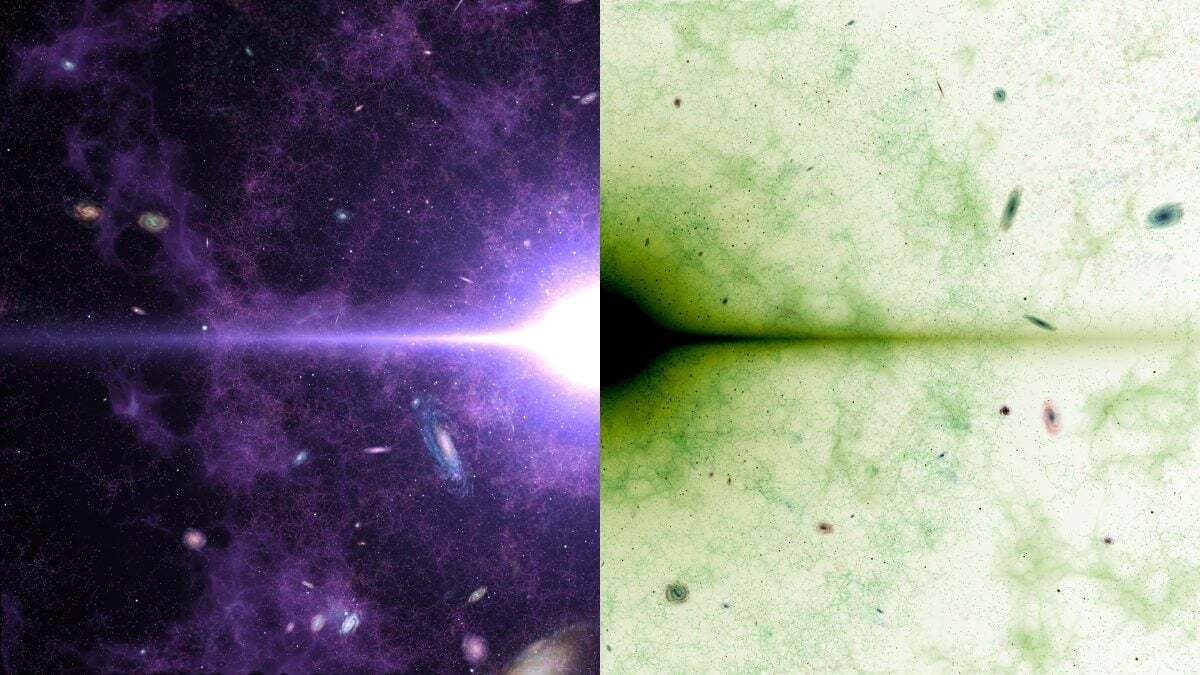
🌌 The Dark Big Bang: Unveiling the Universe’s Hidden Second Origin. Dark matter may have sprung from its own “Dark Big Bang,” separate from the traditional Big Bang, according to new research from Colgate University. "Detecting gravitational waves generated by the Dark Big Bang could provide crucial evidence for this new theory of dark matter," said Assistant Professor Cosmin Ilie, hinting at upcoming experiments that may provide proof for this theory. This alternative theory challenges conventional views of the universe's formation and could reveal a completely new understanding of cosmic evolution. The research team is hopeful that future gravitational wave detectors, such as the International Pulsar Timing Array, will help uncover the mysteries surrounding this potential second origin of the universe.
🦠 Scientists Unveil New Antibiotic to Combat Drug-Resistant Superbugs. Researchers have developed a modified version of darobactin, showing promise in treating drug-resistant bacterial infections like E. coli. "These results show that D22 can inhibit critical infections and highlight the compound’s promise for further development toward future clinical trials as an innovative solution to fight antimicrobial resistance," say the researchers from the American Chemical Society, emphasizing the need for novel solutions amidst rising antibiotic resistance.
🌌 Milky Way represents an outlier among similar galaxies, universe survey data shows. The Milky Way has long been used as a model for galaxy formation, but new studies from the SAGA Survey suggest it may not be typical of other galaxies. Researchers identified 101 similar galaxies, finding that our galaxy's evolutionary history differs significantly, especially in its satellite system, compared to its peers. "Our results show that we cannot constrain models of galaxy formation just to the Milky Way," said Risa Wechsler, professor of physics at Stanford University. This challenges the universality of models based solely on the Milky Way, necessitating a broader view of galactic evolution.
🧬 Scientists announce progress toward ambitious atlas of human cells. Researchers have made significant progress in constructing a comprehensive atlas of all human cells, an ambitious effort aiming to map cellular function and development across the human body. This breakthrough could transform medicine by providing unprecedented insight into how human cells work and how they respond to diseases. "This atlas will be a game changer in understanding human biology," noted Professor Sarah Teichmann, one of the leading scientists on the project【21†source】.
🧪 The Periodic Table Just Got Wilder: Scientists Unveil the Secrets of the Heaviest Element Ever - Moscovium. An international team has revealed that moscovium, the heaviest element ever chemically studied, exhibits unexpected reactivity compared to lighter elements like lead. Researchers say the unique properties of moscovium are influenced by relativistic effects, which may have practical applications in the future. "We have succeeded in increasing the efficiency and reducing the time required for chemical separation," said Dr. Alexander Yakushev of GSI Helmholtz Centre for Heavy Ion Research.
🧪 This Chemistry Breakthrough Might Change Everything From Medicine to Farming. Researchers from the Technion have developed 'triazenolysis,' a chemical process that efficiently forms carbon-nitrogen bonds. This new method could transform polymer, pharmaceutical, and agricultural industries by replacing older methods like ozonolysis, making production faster and greener. "Triazenolysis is an incredible advancement that opens up new possibilities for creating amines efficiently," said Prof. Mark Gandelman, lead researcher of the project.
TECH
🔬 Revolutionizing Light Control: Caltech’s Mind-Bending 3D-Printed Optical Devices. Caltech researchers are revolutionizing optical devices using advanced algorithms and 3D printing to create nanostructures capable of manipulating light in unprecedented ways. This could change the way cameras and augmented reality devices work, allowing precise control over light at extremely small scales. "We actually do not have a rational understanding of these designs," said Andrei Faraon, the William L. Valentine Professor of Applied Physics and Electrical Engineering. "The optimization algorithm evolves them in ways we could never predict".
🛡️ Apple says Mac users targeted in zero-day cyberattacks. Apple released emergency updates after two zero-day vulnerabilities were found actively targeting Intel-based Macs. The vulnerabilities affected WebKit, the core of Safari, making devices susceptible to malicious code when visiting compromised web content. Users are urged to update their devices immediately. "These bugs can be exploited by tricking vulnerable Apple devices into processing maliciously crafted web content," said Apple in a security advisory.
🔬 Korean Scientists Achieve Unprecedented Real-Time Capture of Quantum Information. Korean scientists from DGIST and UNIST have unveiled a groundbreaking quantum state known as the exciton-Floquet synthesis state, which allows for real-time quantum information control in two-dimensional semiconductors. "We have discovered a new quantum state and proposed a novel mechanism for quantum entanglement and quantum information extraction," said Professor Jaedong Lee from DGIST, marking a significant milestone in advancing quantum information technology
HEALTH
🧠 Cannabis Reduces Brain Connectivity: The Link to Increased Psychosis Risk. A study from McGill University has found that cannabis exacerbates decreased brain connectivity in young adults at risk of psychosis. The study suggests that cannabis disrupts synaptic density in the brain, contributing to social withdrawal and lack of motivation. "Not every cannabis user will develop psychosis, but for some, the risks are high. Our research helps clarify why," said Dr. Romina Mizrahi, senior author of the study.
🧬 New Discovery Shows How Gut Hormones Could Hold the Secret to a Longer Life. Researchers at Brown University discovered that a gut hormone in flies can extend lifespan by regulating insulin signaling, a mechanism that could influence aging in humans. This study highlights the potential of gut-brain interactions in developing treatments for aging-related conditions. "We showed how all of these things work together to control lifespan," said Marc Tatar, professor of biology at Brown University.
🩺 New Calcium Channel Discovery Could Revolutionize Chronic Pain Treatment. Scientists have identified a novel calcium channel that plays a key role in chronic pain signaling. Blocking this channel significantly reduced pain in animal models, offering hope for new non-opioid pain treatments.
SPACE
🚀 Thrusters Ignite As Space Station Escapes a Close Call With Satellite Debris. The International Space Station performed an avoidance maneuver using Progress 89 thrusters to evade a piece of satellite debris that could have come as close as 2.5 miles. "The maneuver had no impact on station operations," NASA reported, ensuring all activities remained on schedule.
✨ NASA’s Groundbreaking Artificial Star to Decode Dark Energy Mysteries. NASA has partnered with George Mason University to launch an artificial "star" into Earth's orbit to refine telescope calibrations and study the universe's expansion. "This mission is focused on measuring fundamental properties that are used daily in astronomical observations," said Eliad Peretz, NASA Goddard mission and instrument scientist, highlighting the project's significance in astrophysical measurements.
🌞 Solar Orbiter images capture bursts of activity on the sun’s surface. The Solar Orbiter mission has provided the highest-resolution images of the sun's surface to date, revealing dynamic sunspots and plasma movements. "These new high-resolution maps from Solar Orbiter’s PHI instrument show the beauty of the Sun’s surface magnetic field," said project scientist Daniel Müller, offering new insights into the sun's complex layers.
CLIMATE
🌲 Researchers probe ancient wood for clues about massive solar storms. Researchers from the University of Arizona have analyzed tree rings to detect evidence of ancient solar storms, known as Miyake events, which have occurred six times in the last 14,500 years. "Tree-rings give us an idea of the magnitude of these massive storms, but we can't detect any type of pattern," said Irina Panyushkina, highlighting the unpredictable nature of these events.
WORLD

Gabriel Ugueto
🦅 Unusual 200-Million-Year-Old Pterosaur Fossil Unlocks Secrets of Flying Reptile Evolution. An unusual pterosaur fossil from 200 million years ago has revealed new insights into pterosaur evolution. Dr. David Hone of Queen Mary University of London explained, "This is an incredible find. It really helps us piece together how these amazing flying animals lived and evolved," shedding light on their evolutionary transition from smaller to giant forms.
💥 Ukraine says Russia launched an intercontinental ballistic missile for first time in the war. Ukraine's air force reported that Russia launched an intercontinental ballistic missile during an attack on Dnipro, marking the first known use of such a weapon in the conflict. "It is obvious that Putin is using Ukraine as a testing ground," said President Volodymyr Zelenskyy, expressing concerns over Russia's military strategy.
🌐 'GOFAST' UFO mystery has been solved, Pentagon says. The Pentagon has resolved the mystery of the 2016 'GOFAST' UFO video, attributing the extraordinary appearance to a parallax effect rather than proximity to the ocean. "We assess with high confidence that the object is not actually close to the water," said Dr. Jon Kosloski of the All-domain Anomaly Resolution Office.
🖥️ Google told to sell Chrome to end search monopoly. The US Department of Justice has proposed that Google sell its Chrome browser as part of a series of remedies to prevent it from maintaining a search monopoly. "Restoring competition to the markets for general search and search text advertising will require reactivating the competitive process that Google has long stifled," government lawyers wrote in the court filing.
Thanks for reading!
Reply